Raise your hand if you already knew that Chick is a recovering reactive dog. Good, that’s a lot of you. We have written about it openly in the past, in the hopes that we can help others stop feeling ashamed of their dog’s unsavory behaviors.
Ok, now raise your hand if you knew that Doodlebug is a reactive dog too. What’s that? None of you? Well, that probably makes sense, since until about a week ago, we were on your team too.

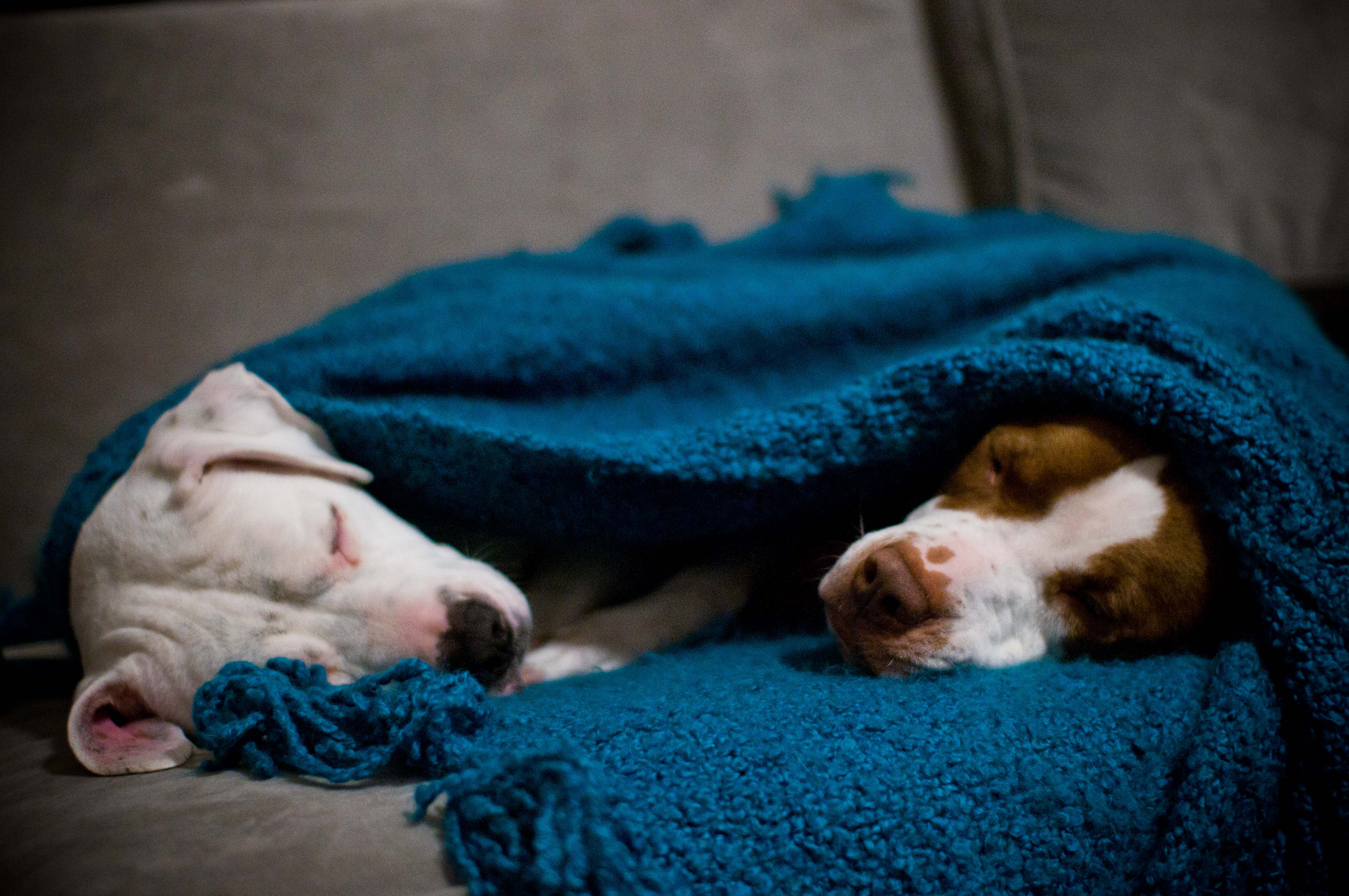
How can this snuggle-pile be full of reactive dogs?
We’ve done a lot of thinking and learning about reactivity over the past years, but a lot more over the past week or so since we’ve started to understand that we’re dealing with a bit of it in our Doodlebug. Just yesterday morning I was thinking about the phases of caring for a reactive dog — the long period of not understanding or not admitting it, then the scary journey toward facing our fears and moving forward, and finally that sense of accomplishment that comes with knowing that we have a plan for whatever situation we find ourselves in. Our journey with Chick’s reactivity has been lifelong, but we spent years in the pre-action phases and reinforced a lot of bad habits before we found the courage to move forward. With Dude, we figured out what was going on in a snap. It may still take months or years to get to our end point, but just knowing that a positive path exists and we’ve taken the first step is a huge sigh of relief.
Our five phases are based solely on our own experiences working with reactive dogs in our home — everybody’s phases might be different!
1. Realization. Maybe your new dog took a while to come out of her shell, and was perfectly polite and neutral toward dogs at first. Or maybe your puppy didn’t start showing signs in the first year of his life. Or maybe you built up a high wall around your dog so she never had a chance to express her reactivity before. There is a whole catalog of reasons that you may not realize you have a reactive dog on your hands — these are just three. With Chick, we were in this phase for a few months, and with Dude, we were there until last week.
2. Denial. Then something changes, and maybe you start to see hints of reactivity here and there. A surprising growl at a motorcycle whizzing by the house. Or a lunge and snap at a cute puppy on the trail. Or some extreme pulling, panting, and whimpering every time you pass a dog jogger in the neighborhood — suddenly more intense and focused than in the past. But obviously, these incidents are flukes — easily explained away . . . right? The motorcycle just startled him. He was just excited to play with the puppy. He is jealous of dog joggers and wants to join in. She can’t be reactive, she lives with other dogs and three kids! But, you’re in denial. Denial is one of the two dangerous phases of reactive dog ownership because during this stage, we’re constantly testing our dogs. We assume that the growl or lunge or bark or whine was just an isolated incident, and we keep putting her into situations where she should prove us right — after all, she is not a reactive dog! We keep running them through crowded areas or bringing them to the farmer’s market, and they keep proving to us that they’re not comfortable. We keep making excuses “She’s just nervous,” or “He’s not feeling well.” In the meantime, our dogs are getting more and more practiced in the art of growling, lunging, barking, staring, or — in rare cases — biting. We spent about a year in this phase with Chick, and only about a week with the Dude.

Ready to practice my lunging and barking.
3. Panic. After sufficient testing in which the dog proves that she does not, in fact, know what is expected, most of us with reactive dogs get to this phase. And it’s not a fun one. Only the experienced dog handler — or the person who came into the situation understanding that she is dealing with a reactive dog — can skip over this stage altogether. The panic phase is characterized by the kind of handling that actually exacerbates the dog’s reactivity rather than helping the dog make better choices. Every time we seize up on that leash or yell at a dog who is barking and lunging, we are sending a message: “There is indeed something to be worried about. I am worried too.” For sensible and experienced dog handlers, this phase is short-lived. You realize that you don’t know what to do and your dog certainly doesn’t know what to do, and you call in professional help. For others of us — especially novices like I was when I adopted Chick — the panic phase can last months or years. During this time we can accidentally be training our dog to be aggressive, by sending the exact wrong signals during moments of stress. We sometimes joke that you have to first train a dog to be aggressive before you can become a good dog trainer — and at the center where we train, it’s true of almost all of the staff. The panic phase is a dangerous one, so it’s best to take a deep breath, have a stiff cocktail, and regroup as soon as you’re able. You can work through it! We panicked for a year and a half with Chick before we sought help; with the Dude we were in this phase for two days — from last Sunday until this past Tuesday.
4. Progress. Eventually, you might realize that you don’t want to live in fear, looking over your shoulder the whole time you’re walking your dog. You want to be able to proudly take your dog in public and understand what to do in a variety of scenarios. So you seek help. The bravest of us pick up a good book — like Patricia McConnell’s “Feisty Fido,” and go it alone. Others will look for an experienced private trainer. Still others will join a group class — whether a simple obedience class or a specialty class for reactive or fearful dogs. We reach out to friends and colleagues for advice, and we start to take baby steps. Eventually the baby steps add up, and we start to see a positive change. We gain confidence and keep moving forward. Sometimes we take a deep breath and congratulate ourselves on our accomplishments.
5. Management. I’m so lucky in my new line of business that I get to be exposed to dogs in all stages of the reactivity. The most inspirational — obviously — are the ones who started out totally wild when exposed to their triggers, and have gone through all five phases and learned so much in the process that they can now comfortably go anywhere and do anything. This is where we all hope to end up. But management is a broad spectrum — some dogs are cured, so to speak, of their reactivity, while others still need to be worked, reminded, and handled skillfully in challenging scenarios. Chick falls into the latter camp. If we let our guard down completely and let him be in charge of his interactions, he might get into trouble now and again. But as long as we keep him focused and working in tough situations (like when walking or hiking around off-leash dogs), he can really shine. For Doodlebug, we’ve set our sights even higher. Follow along on our journey as we help him work on himself!
If you’re a dog owner caught in the denial or panic phases right now, please seek help. There’s no shame in reaching out for assistance. Reactivity is rooted in a million different causes — fear, frustration, playfulness, panic, medical issues, and others — but the common elements are usually (1) a dog not understanding what is expected; and (2) well-practiced inappropriate reactions. Both of these elements can be countered, and the sooner you start working on it, the sooner you will succeed!













 Love and a Six-Foot Leash