how to keep on keeping on

**We have been overwhelmed by the kindness extended by so many individuals after our difficult ending with Baby Blue last week. Rarely have we felt so loved and so supported. Your good will has been a true gift to us, and for it we are so grateful. Thanks to each of you who sent your thoughts for Blue and for us.**

you take a few sips of bourbon for your heartache, a couple of advil for your headache.

you call a dear friend — the kind that can interpret your tears over the telephone.

you go for a long, long walk with your own dog soulmate, stopping every minute to give him a hug and a treat.

you replay everything in your head, asking yourself if it could have been different. (it couldn’t have).

you read all of the kind words of sympathy and support offered by friends and strangers. you let your heart swell with gratitude and thankfulness.

you call up one more memory of the happiest moment you spent together and hold it in your mind for a short while. you smile through the tears. for the umpteenth time that day, you resolve to be brave.

then you take a deep breath and remind yourself that your work is not done. you go back to the kennel again to meet the cries, barks, wags, and licks of all the other beautiful, worthy, sad, lonely dogs that you could still save, one by one.

and maybe you start with this one.

Goodnight, sweet Blue

Yesterday, we said goodbye to Baby Blue. We gave her a big breakfast, took her on a long walk, let her play with her favorite toys, and allowed her up on the couch for a while. Then I loaded her up in the car, bought her a cheeseburger at the drive-thru, drove her up to the shelter that had tried to save her, gave her a treat and a big hug, and held her in my arms as she went peacefully to sleep.

We didn’t know it was going to turn out this way, but we knew that the odds were against us.

Blue’s timidity and behavior at the shelter made her a little too questionable for a traditional adoption, so in order to get to know her better and further evaluate her, Blue was placed with us, an experienced foster home. We wrote gently about the uncertainty of fostering Baby Blue a few days ago, but didn’t put it as bluntly then. Probably because we held out hope that we could work miracles. Now the truth is before us, as plain as it is painful. Baby Blue was not adoptable.

I’ve had a lot of ideas before about the hardest part of fostering: maybe the hardest part is falling in love with a dog and then having to say goodbye when its forever-family comes along. Maybe it’s realizing that your new foster is more of a handful than you had expected. Maybe it’s picking one from the shelter and knowing that the one you didn’t pick may not make it.

Turns out this all pales in comparison to the real hardest part of fostering: realizing that no matter how much you want to help, you can’t fix every dog. Loving a dog, but coming to terms with the fact that it is too troubled for this world. Trying to snuggle her fears away, only to realize that no amount of snuggling will ever be enough to make her feel safe. Recognizing the signs of insurmountable fear or inability to interact with the world.

When a dog bites.

After Blue came into our home, it became heartbreakingly obvious that she had not been properly socialized as a baby and held a deep-rooted suspicion of people, especially men.

A lack of socialization can be addressed through positive training and rehabilitation and does not necessarily make her unadoptable. When she was confronted with an uncomfortable situation, sometimes she would try to hide, other times she would bark or growl, and sometimes she would lunge and snap. This type of fear aggression can also be worked with and does not make her unadoptable. But sometimes, she would nip or bite with no obvious provocation at a person who was being still and not making any noise. A few incidents like this over her first week with us made her unadoptable under our shelter’s policy.

These incidents were also the crux of the problem. Without easy-to-decipher triggers and varying red flags from Blue, we had only the vaguest idea of what was causing her behavior.  We consulted behaviorists and dog pros who agreed that this particular behavior was extremely difficult to work with and that she may not be a safe adoption candidate.

The foster/ownership equation-changer.

If Baby Blue were our own adopted dog, this story may have turned out differently. We would have seen trainers, doctors, and behaviorists. We would have worked hard with her to earn her trust and help her explore the world in a non-threatening way. We would have to make some serious adjustments to our life, in an attempt to create a safe, stress-free existence for her. And even then, we might have come to the same conclusion that we did as her foster parents.

But as foster parents, our responsibility is not only to help prepare a dog for adoption, but also to help evaluate dogs for their suitability as family pets, so that we are helping to place safe dogs into society.

Given the severity and complexity of Blue’s issues, we did not feel that we could confidently introduce her to potential adopters. We also questioned the effect that another major life change would have on Baby Blue, who clearly was so stressed by novelty that she felt the need to take extreme measures to protect herself, even from the kind, non-threatening people who move slow, speak softly, fed her, and shared her home.

The breed issue.

Through blogging about Baby Blue’s issues, I’ve heard so many stories from others about their experiences owning or fostering fearful, reactive, or aggressive dogs. Those stories have varied as much as the types of dogs they were about. We’ve heard about aggression issues with labs, poodles, bloodhounds, shepherds, boxers, and little fuzzy mixed-breeds. A dog’s likelihood to bite has little to do with its breed type and everything to do with its unique, individual combination of environment, history, genetics, temperament, and management by humans.

Unfortunately for her, Blue drew some short straws in early life.

Compassion holds.

When we first came to this realization about Baby Blue, a close friend sent us a beautiful story from BADRAP about fosters who do compassion holds – take care of a dog temporarily who is either too sick or too troubled to be adopted. Compassion holds allow the dog some solace and peace from the big scary world in the dog’s last days, weeks, or months. People who do compassion holds are angels. I can’t imagine anything more selfless than giving your own heart in this manner. After semi-unexpectedly ending up as Blue’s compassion hold family, I have all the respect in the world for these good people. The full piece is here.

So goodnight, sweet Baby Blue. We wish we could have built you a beautiful world that makes you feel safe and protected. We have comfort in knowing that today you’re running happy and free amongst the stars and constellations.

A new blog feature!

So, we at Casa Fosterfamily have been a little jealous of all of the pretty blog improvements that some of our friends have been making lately, and thought we should try to spiff up our own blog a little in honor of (1) the arrival of our fourth foster dog and (2) our blog hitting the milestone of 50,000 hits.

We thought a good area to spiff up would be one focusing on our past dogs so that any of our newer readers can learn more about the other beauties who have shared our home. So, check out our new Past Fosters page*! There you will find fun little photos and brief descriptions of each of our past fosters. It gets even better! By clicking on whichever dog you’d like, you will be taken to that dog’s very own biography page where we’ve summarized our time together, including plenty of links to individual posts from their time in our home, in case you care to learn more.

*if you prefer an old-school link, use this: https://loveandaleash.wordpress.com/past-fosters/


On learning a new dog

One of the highlights of fostering, for me, is getting to know a new dog. I love seeing a photo and reading a bio, and then experiencing the anticipation of how the new foster will be in real life. How will s/he fit into our family? What will his/her cutest quirks be? Biggest training challenges? Most surprising characteristics?

With a new dog, I am also always anxious to understand her/his personality so that I can try to convey it photographically and in words. One of my many untested theories is that adoptable dogs with a distinct “personality” have a magical sort of draw to them, making them more attractive to potential adopters. Our first foster, Lollie, was a classic lovable underdog. She was a big sweetheart with a sad past who had a lot of heart, and really wanted to win the world over. And she did. We dubbed her Lollie Wonderdog. Next was Gonzo. Gonzo was a pocket rocket. He was a tiny little ball of mischevious antics. He had tons of energy and didn’t much care if anybody liked him, but with that face and those ears, people just couldn’t resist.  His name became Gonzo Bunny-Ears.

TANK’s persona is still evolving, since we’ve only had him about three days and upon bringing him home, we knew much less about him than his predecessors.  He doesn’t yet have his middle name, which we like to bestow upon our fosters. So far we know that he is a big, goofy, oafish, friendly lug who is absolutely jazzed with life. Other aspects of his personality are coming out, but we are just barely starting to fit together the puzzle. It’s hard to resist, but we’re trying not to rush: the discovery is one of the best parts.

Here’s one piece of the TANK puzzle: in the house, he is an enthusiastic, bouncy youngster who is constantly moving, licking, chewing, running, and jumping. He will learn how to be a good house dog quickly, but at this point he is acting like a typical 60 pound puppy with little training. But outside? Outside he is the calmest dog I’ve ever met. He walks slowly next to me on the leash, almost never gets excited, and occasionally even decides to lay down in the grass to rest and smell the clover. And once he’s down, there is little that will convince him to get back up except his own free will.

A letter to Gonzo in his new home

Dear Gonzo Bunny-Ears,

Thank you for being such a good boy and barely whimpering when I left you at your new home with your new people. I was so delighted to learn that you were not only a brave fellow, but quickly forgot about us after I left, just as I had hoped you would. After all, your new parents, C and J, are so wonderful, and your new sister Laila — a 95 pound presa canario — well, she’s just a dream. And I’m sure the milkbones helped too.

When I first heard from C and J and started corresponding with them over email, I thought they were too good to be true. And when they came to the adoption show with sweet Laila to meet you? I just about died from the cuteness of the two of you together. You probably don’t realize how small you are or how big she is, but Gonzo. She is almost three times bigger than you! 

Later in the week when they brought Laila over to our house for a play date, since you never did like the adoption shows very much, we were all nervous about how things would go. Would you like her? Would her rambunctious, boxer-like play style be too much for your tiny self? We already knew that you far prefer big dogs to small dogs, and that Laila always seeks out the little guys at the dog park, but still . . . would you be a match? By this time their application had checked out perfectly, so this was the last step, and the stakes were high! Your co-walk went fine, and the two of you even got to bond over near-simultaneous pooping, do you remember? You probably didn’t notice that Laila’s poops are almost as big as your head, did you. We also learned that you share an affinity for pooping multiple times on one walk — something that drives me and foster dad crazy.

Once we let you loose on the deck together, you did great. It is difficult to describe the joy I felt as I watched you sail through the air — seemingly in slow motion — to give your sister a good love-nip on the neck, and watched you both tumble to the ground, only to writhe on deck, side by side, two backs on the ground, eight paws flailing, two mouths open, and two tails beating on the wood planks in a hyper happy rhythm.

Gonzo, I hope you don’t forget all the things we talked about before you left. I hope you remember how to be a gentleman, and to let your new sister win games of tug-of-war now and then. I hope you are a good snuggling partner and don’t hog the very center of the bed like you so often did with your foster-brother Chick. I hope you remember to always pee outside and never inside, not even a little squirt now and then when you are exceptionally excited. And Gonzo, I hope you remember us. Not as your parents, but as some nice people who helped you make a graceful transition from your former life to your forever life.

And finally, Gonzo, you have touched our lives in an unexpected way. Just like the rest of the world, we have been hypnotized by your good looks and your bouncy, care-free attitude. We never thought we would see the day when a totally adorable, totally uncontroversial, tiny pocket-pittie would steal our hearts. We thought we were underdog people, and Gonzo, you are not and underdog. And to a large extent, we are still underdog people. But you have helped us realize that above all, we are dog people. Every dog has a story to tell and a special gift to share. Thank you for sharing yours with us. You have expanded our horizons, and we love you very much.

With eternal affection,

Fostermom and  fosterdad (and brother Chick, whose affection has surprised even himself, since he thought he could never love a dog smaller than his 50 pound self)

PS- here are a few photos of you, your sister, and your new parents — partly for you, partly for your fans.

PPS- the first photo is one of your foster mom’s favorite photos of all time.

rescue adoptions: one group’s perspective

We are fostering Gonzo through a different group than we went through for Lollie, so we are in the middle of a steep learning curve of rescue philosophy. It’s been interesting for me, because my natural inclination is more aligned with the “no-kill nation” philosophy of getting as many animals into seemingly good homes as possible, than with the more common rescue group approach of searching very carefully for the most perfect home possible. Both approaches have their points, but the debate between them is not the subject of this post.

Many rescue groups — including Partnership for Animal Welfare (PAW), through which we are fostering Gonzo, ascribe to the latter of the two approaches above.  In many cases the dogs taken in by rescues have been victims of irresponsible dog ownership, which makes a rescue that much more discerning in reviewing potential adopters.  PAW devotes a lot of time and money to the dogs it selects, through foster care, extensive vet treatment (including major medical — one of the few groups in the DC area to take dogs who need serious surgery), training, and PR.  Because of the rather large investment, PAW feels a responsibility and a right to be very selective and thorough in picking exactly the right home for a dog.  Whereas most any responsible adult can go to a shelter and adopt a great dog, adopting through some rescues is a much more involved process — one with a number of steps and a lot more scrutiny, but with a payoff: arguably greater peace of mind, because in adopting from a rescue and out of foster care, a family can know much more about the dog’s personality, preferences, medical history.

Through the process of fostering Gonzo with Partnership for Animal Welfare, we have learned a lot about how applications are picked, which are considered “strong,” and which are not. Here are a few guidelines that I have observed based on recent applications for Gonzo.   They may offer a bit of insight into what rescue groups look for, but specific qualifications will vary a lot from dog to dog and from group to group.

1. Pet as family member. Sometimes I am amazed at the seeming lack of care with which people fill out their applications, or the different standards people have for what is normal. People who plan to keep the dog outside or in the basement, or admit to going to the vet “only in emergencies” are going to be tossed aside pretty quickly.

2. A compatible family composition. People who live alone and travel extensively for work will raise red flags. Dogs are very adaptable, but having to stay at the kennel or at mom’s house every other week while an owner travels is not ideal. Likewise, if the dog is a bit snappy, growly, or very energetic, it probably isn’t best for a family with a young child. If the dog is very timid, it won’t go well with a family with several tweens. If the dog is dog-reactive or thinks of cats as snacks, an application with other pets in the home will probably be declined.

3. Stabiliy. Many pets are given up to shelters when an owner or family moves, divorces, loses a job, moves in with a new partner, etc. Most of these are impossible to predict, but there are some signs that rescues may look for — a very young adopter in his early 20s, or somebody in the military who may be placed overseas, is not seen as the strongest candidate for a rescue adoption.

4. Housing constraints. We foster pit bull type dogs, which means they can’t be adopted by somebody who lives in a county with breed-specific legislation (aka BSL, or a ban on particular breeds like pit bulls) or an apartment or house with similar constraints. Many people are surprised to learn that their apartment does not allow bullies, but it’s unfortunately a very common rule. If a dog is a fence jumper, it can’t go to a house with a 3′ chain link fence, unless the family is committed to building a taller fence or only walking the dog on leash.

5. The vet check. Most rescues will call the current or prior vet used by a prospective adopter to find out the record of shots, vaccines, and medicines. If an applicant is overdue for several important vaccines or tests, the application may be declined — although you can be a perfectly responsible pet owner and accidentally miss a vet appointment now and then, missing vet checkups doesn’t reflect well.

6. Experience level. Some dogs are much better suited for people who have substantial dog experience, while others are easy and care-free, and could be great for a first-time dog owner. Our first foster Lollie needed an experienced dog family who was willing to work with her, while Gonzo is easy, and would make an ok first. But still– many rescues feel more comfortable placing dogs in the hands of experienced dog people, even for easy dogs.

7. Lifestyle issues. Gonzo, for example, does not like to be alone. All dogs are social, but Gonzo really does seem to suffer from a higher level of stress than others. When he is with us and/or our Chick, he is a different dog. Mellow, happy, and relaxed. When he is alone, he worries. Extensively. So for him, the best kind of family will be one where somebody is at home a lot, or there is another pet in the house. Singles or couples who live alone and are away for a standard 8 to 7 workday would make wonderful dog parents to many dogs, but probably not to Gonzo — this little fella just needs more.

After considering all of these issues, it’s easy to see why a dog in rescue care could receive a number of applications before being matched with an adopter who truly is a perfect fit. And if I ever have the opportunity, I like to remind people who are interested in, but not able to adopt Gonzo — he sure is cute, but he really isn’t unique. Our shelters and rescues (including, in our area, MCHS, WHS, and WARL) are full of wonderful dogs with big warm hearts and cute, expressive ears, who deserve nice homes just as much as our foster. He happens to be lucky to be an internet star with his own blog, but that doesn’t make him any more worthy of a good family’s love. In fact, all of those dogs who spend their days in a cold, barren cage with nobody taking cute pictures probably need their attention more than our Gonzo does.

on dog puzzles and the greatest dog trainer that ever was.

Mr. Gonzo Bunny-Ears has really taken to eating his kibble and snacks out of dog puzzles. We have been feeding our own Chick in this manner for years so to us it’s second nature, but often we get questions from bloggers about the types of puzzles we use, how we use them, when, etc.

Shortly after we adopted Chick as a young chap of two or three, he developed pretty severe separation all kinds of anxiety. He would pace nervously when we were getting ready to leave. Decorate the house with the garbage while we were gone. Refuse to eat for days during car trips. Never let us out of his sight when we were home. So, we went to a trainer. A first class, badass trainer.

Lee Mannix had a way with dogs. He was one of those people who can just communicate with them, and they with him. His craft was not teaching dogs “sit” or “shake” but rather teaching owners how to understand and interact with their dogs to prevent, treat, and manage problem behaviors. And his creativity seemed limitless. Some of the tips and tricks he came up with to help us deal with silly problems – like Chick pulling dish rags off their hooks – not only worked flawlessly, but boggled the mind. The human mind, that is. Lee left this world about a year ago, but his personality, his methods, and his lessons live on. For a longer account of the magic of Lee, read here.

But I digress. The first thing Lee asked of us was to stop feeding Chick food in a bowl. Ever. From that day forward, he was to eat only through training (kibble as reward), or in various mentally challenging games (kibble as problem solving goal). The idea was, that if meals are no longer predictable and punctual and effort-free, the dog will become more “willing to please” the owner, knowing that he’d better watch carefully lest the puzzle come soon. It also helped keep the dog busy for a while, so that we could hand him a snack, leave, and he would be so busy working on it that he wouldn’t remember to get worked up and anxious.  So we went from two meals a day, in a bowl, to five or six meals a day, in all different ways.

The simplest, and perhaps our favorite method to date for its sheer convenience and free-ness, is the Gatorade bottle. Take the plastic ring and the label off, wash and dry, shake a little kibble in, and hand it to the dog. A beginner dog may take 30 minutes to get the kibble out, trying to get at it with his tongue or his claws. A veteran only needs a few minutes. As a bonus, the dog eats more slowly than from a bowl, aiding in digestion and reducing gas.

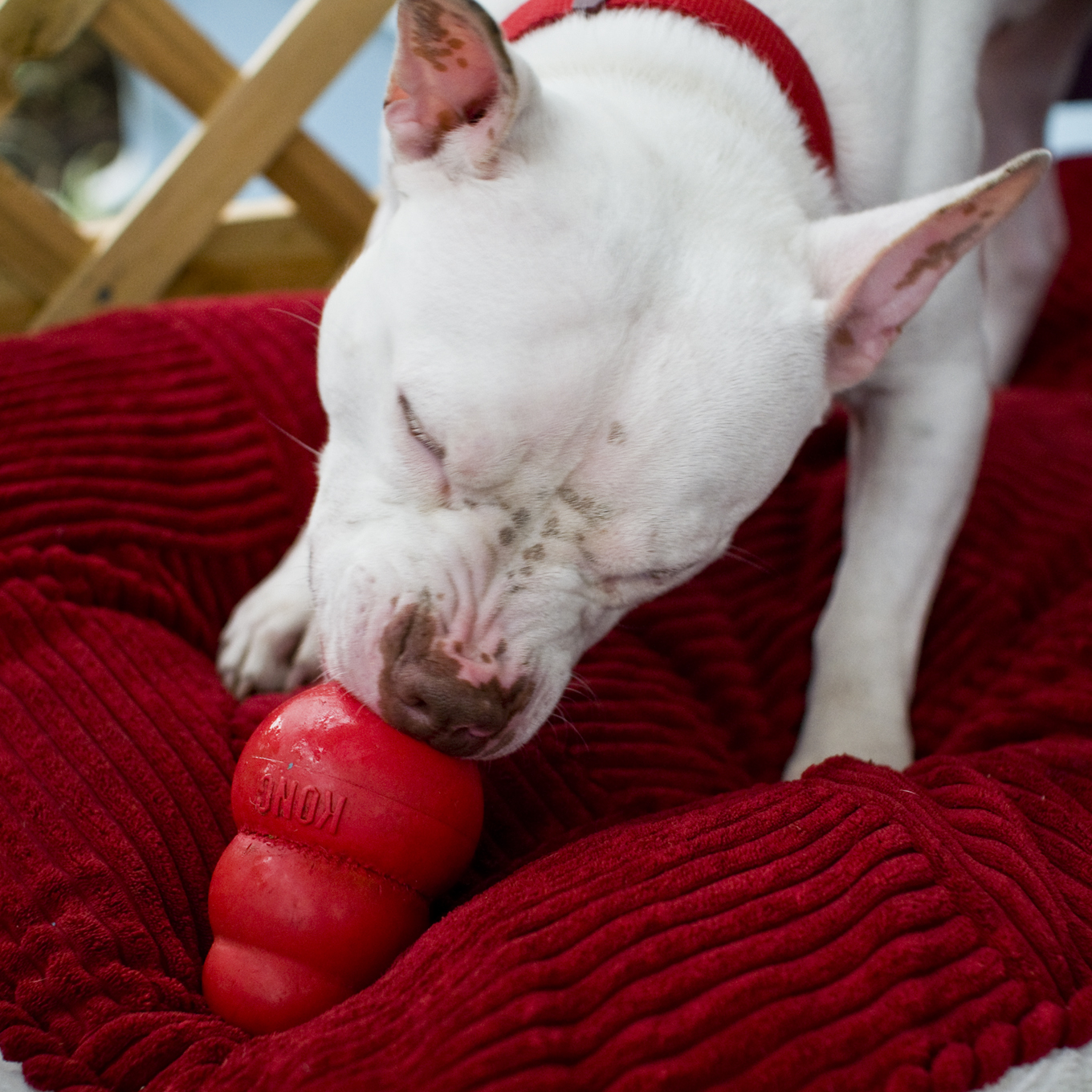
Our second favorite is the grandfather of all dog puzzles, the kong. The easiest way to kong a dog is simply to scoop some kibble in, and seal the opening with something sticky – some peanut butter or cheese whiz works well. But this is too easy for our little geniuses.

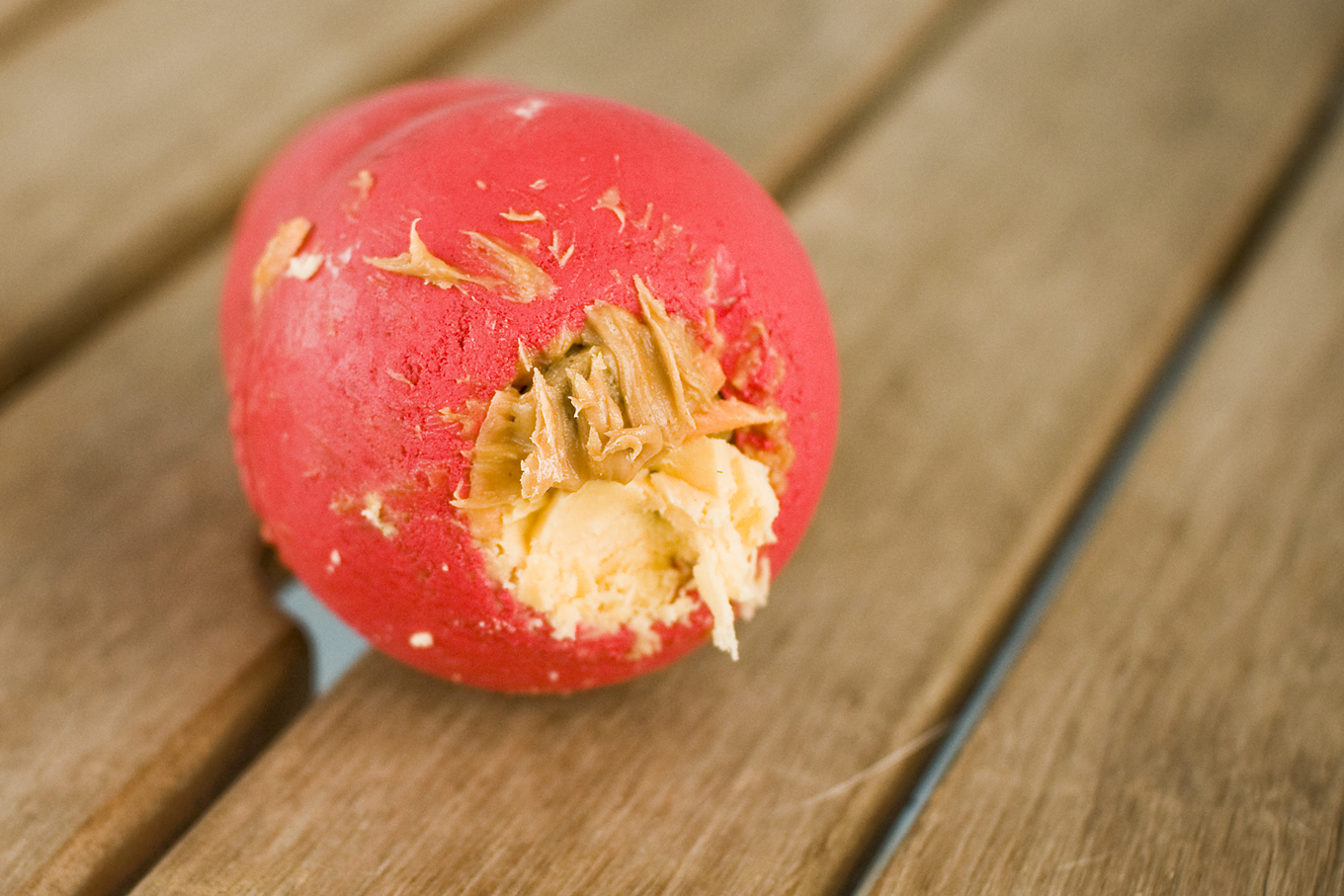
To make a kong more difficult, we started to put a little peanut butter, yogurt, or cheese at the bottom of the kong, add the kibble, then seal the top. This way, dog has to extract the very end of the goodies with his tongue. For our geniuses? Still too easy. The next phase was mixing the kibble with yogurt or runny peanut butter in a bowl, and then stuffing the kong. The whole mixture is sticky and wet, so it takes a lot more tongue action to finish the work. This is challenging enough for Gonzo; it takes him about 20 minutes to finish one of these. For Chick, though, we have to take it to the next level: the freezer. Once frozen solid, it takes even an advanced chewer a while to get all the goodies out.  Our normal filler for these kongs is a combination of kibble, peanut butter, raw veggies, cheese, and leftovers – whatever we have that is dog-friendly and not likely to be otherwise eaten.

We usee many other food-dispensing devices and toys also, as Gonzo is modeling here. But the two originals, the ones shown to us by Lee, will always remain our favorites.

For more info about adopting Gonzo Bunny-Ears, contact us at DCpetographer [at] gmail [dot] com or through Partnership for Animal Welfare.

Chick’s position on fostering: still not impressed

Fostermom and dad enjoy fostering for the reasons we have already explained and the reasons we will explain next time we have the time to sit down and write about them, but as for Mr. Chick, our own loverboy, he is not so sure.

Of course, he has dog friends. He even has dog kindred spirits, like his uncle Tex the lab, and his old Texas pal Pancho the mexican bandito. But for the most part, Chick’s attitude toward other four-leggers of the canine variety is one of reluctant tolerance. He will leave them in peace, and ask the same in return.

You can tell by his utterly unimpressed and squinty expression in this sorry excuse for a portrait of him and Mr. Gonzo Bunny-Ears:

The only good thing in the photo is that it gives you a little bit of a sense of how very small Mr. Ears is, when compared to the very normal-sized Mr. Chick. Note how Chick has his legs all the way down on the step below,  and he’s just as tall as an upright Mr. Ears.

Chick’s real complaint with fostering Mr. Ears in particular is that Gonzo is full of boundless energy and is constantly running up to Chick, bodyslamming his tiny body against Chick’s, and saying (with his body language) “hey bro, wanna play? huh? huh? huh?” To this, Chick squints his eyes unamusedly, sighs, and saunters off to another room.

Gonzo has also learned that Chick’s back is the perfect height for putting your paws up on, especially if you are trying to reach, with your tongue, a cooking utensil in your foster mom’s hand. Chick does not find this entirely entertaining, but bears it stoically.

Not that Chick doesn’t like fun. It’s just that Chick takes his energy in small, very enthusiastic bursts, and when he’s not in a burst, he prefers to have fun by reading the paper and sipping a cup of joe. And he’d prefer if you would refrain from wrinkling his paper or spilling his coffee, thank you very much.

Why we foster: part 1 of 2

Our decision to start fostering was not rooted in one single reason, although I could most cleanly trace it back to this: I have always wanted to foster dogs. It’s an intangible and squishy reason, which makes it an utterly unsatisfying answer. So last week after our very first foster, Lollie Wonderdog / Lily Fireworks, moved into her new forever home, I thought it was time to search for better answers. I came up with a few. The first two are below. The next few to come.

Chick is a good mentor.

Our resident wonderdog, Chick, really is a model dog. He has impeccable manners, never says a peep, wouldn’t dream of asking for anything, is the best cuddler in the world, and has the most expressive ears and eyes. He has been an excellent tutor in good behavior to his rather uncivilized uncle Tex the black lab, who in his worse days is a slobbery, bouncing, yipping terrorist (though on his good days, thanks to Chick, he is sweet and quiet). I have always had a nagging feeling that it is a waste of Chick’s excellent dogness not to share his talents with other animals who are still learning how to behave. He may not have taught his foster sister Lollie/Lily much, but he did teach her how to pee outside, and that certainly counts for a lot.

teaching tex how to bounce

Pit bulls need all the advantages they can get.

It’s easier for a camel to pass through the eye of a needle than it is for a homeless pit bull to get out of a shelter alive. Is that how the old adage goes? I won’t depress you with statistics, but pit bulls really do have a hard time being adopted. They have an unreasonably bad reputation (although fabulous groups like BAD RAP and StubbyDog are working hard to turn this around), and with so many worthy dogs available in shelters, pit bulls are often overlooked. I have often said that people who don’t already adore the bully breed group are just people who haven’t really spent time with any bully types. Put simply, many people just don’t know what these dogs can be like, and can’t picture one in their lives. Fostering is a perfect way to counter this all-too-common lack of imagination. If we, a non-controversial young professional couple, bring a foster pit bull into our home and successfully demonstrate how perfectly a dog like Lollie/Lily can fit in, won’t that open some minds? It’s hard to make any sweeping generalizations, but since we took Lollie/Lily in, handfuls of people have written us to say that their eyes have been opened.

noncontroversial Chick and his somewhat controversial hand-knit sweater

A letter to Lollie in her new home

Dear Lollie Wonderdog,

Thank you for writing us to tell us that you got home safely, went for a nice walk with your new people, and got snuggled in to your new gigantic crate. We are happy to know that like your new mom, who is a real nurse, you have a real knack for treating illness, and you gave your new brother Isaiah lots of licks to help with his fever.

We did think about you a lot after you left last night (I only cried a little, and I hope your new mom’s eyes stopped watering too after you guys drove away). We sat on the front porch to take in the unseasonably warm weather and have a beer, and wondered what you thought of your new neighborhood and your new people. We know it’s going to be an adjustment, and it’ll probably take you a few weeks to really feel “at home” — even though you are a wonderdog– it took you even longer with us.

I hope you remember the things we talked about before you left. Please try not to jump up on your new human brother and sister and knock them over. We know it is hard to learn a different way (other than the natural dog way) to greet people and show them you like them, but please try. When you’re walking on a leash, please try not to pull, even if you discover that pulling doesn’t make the walk stop and stand still until you quit it. The treats will come more quickly if you walk like the good girl that you are. I promise. When you are feeling restless, please try to take to an activity rather than spit-cleaning your new mom’s boots or pacing endlessly around. You found a lot of satisfaction in solving puzzles, playing fetch, and extracting treats and peanut butter from kongs and other toys, so remember to grab a nylabone when you get bored. And while we’re on the subject, please try to keep straight which objects are for chewing and which objects are not for dogs. I know sometimes it’s confusing — especially with firewood and shoelaces — but listen to your new family. They will help you learn.

Lollie, you pass through the world with a carefree grace that I have rarely seen in a dog, and have never seen in a person. Your ability to make everybody like you and the whole world smile, paired with your ability to overcome anything with a wagging tail and a flapping tongue is truly remarkable. I hope you don’t remember the specifics of how you ended up in that dumpster in September, bruised, half-starved, and filthy, but I hope you always remember that you have overcome so much — and come out a shooting star. An eternal firework.

Lollie Wonderdog, it’s an amazing thing when a sad little dog can teach a bunch of humans so much about perseverance, patience, and overcoming the odds. You have touched our lives forever, and we love you very much.

With boundless affection,

Fostermom and Fosterdad (and Chick, but his affection has very clear boundaries)

Lollie and her new sister Olivia, ready to go home