To donate: Click here, select “Schrodi Training Fund” from the dropdown menu, and type the word LOTTERY in the “dedication” field to be entered in our holiday giveaway (now through December 7). For more info on the fundraiser and the holiday prize pack, click here!
* * * * *
Many dog trainers can easily name the dog who made them decide to become a trainer. For most of us, it was a “problem child.” One who defied the norms. Kept us on our toes. Required that we bust our butts to get him under control. Made us fall in love more deeply than we thought we could. For me, that dog is Chick. For Shari Elkins, that dog was Schrodi.

About Schrodi
From day one, Schrodi was a firecracker. She was Shari’s first dog as an adult, and she never for a moment let Shari let her guard down. Her wild behavior had Shari looking everywhere for a fix. Over time, and at least partly due to a lack of guidance from the right trainer, Schrodi’s behavioral challenges devolved to a worrisome point. Shari often admits that she made her dog aggressive — not purposely, of course. A few years later, Shari met Lee Mannix, a legendary Austin dog trainer. Under Lee’s instruction, Shari and Schrodi learned to trust one another and work together, and Schrodi blossomed and became an exceptional dog. Even now, Shari talks about Schrodi as the best dog she ever had — the dog that made her a dog trainer.

Schrodi died some years ago, but Shari wanted her legacy to live on. And what better remembrance than offering quality rehabilitative training to dog owners who can’t afford it, so that they can train and keep their dogs?
Making Help Affordable
Shari, now the training director at the Canine Center for Training and Behavior, founded the Schrodi Memorial Training Fund in 2008 as a way to commemorate Schrodi’s legacy and help Austin’s dog owners access the training they need regardless of their financial situations. Behavioral issues continue to be the #1 reason that dogs are surrendered to shelters, and especially in a weak economy, the need for affordable training — especially private lessons to address behavioral issues — is great.

Austin is a remarkable community in that many groups offer free or low-cost basic and intermediate obedience classes, including our Doodlebug’s own Love-A-Bull. Programs like these go a long way toward the goal of keeping dogs in homes and grooming responsible dog owners. But for some dogs, a group class just isn’t the solution.
In 2010, Schrodi Fund brought 80 families in to the Canine Center who would otherwise not have been able to afford the help they needed. Of the dogs helped that year, 95 percent remained in their homes. Given the range of behavioral challenges we see through the program, this success rate is astounding.
Over the past year, I’ve been lucky enough to personally refer two of our blog readers to the Schrodi Fund, and gotten to meet each — and their lovely dogs — in person at the Center for their evaluations and subsequent training.
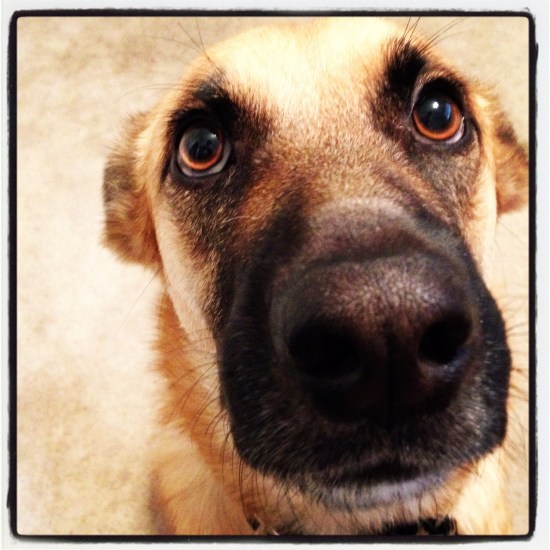
Shiner’s Story
I first “met” Shiner through this blog when her owner, L, emailed me to ask about the Center’s reactive dog class. She and Shiner were in a class at another training facility where one of the methods of “training” Shiner not to react to other dogs was to jerk the leash so hard that Shiner would — literally — flip over. L had a bad feeling about the class and how things were going, and reached out to me to inquire whether the Center’s methods might be more up her alley. L had originally selected the other class because it was less expensive, and she and her partner needed to make the most of their limited training budget.
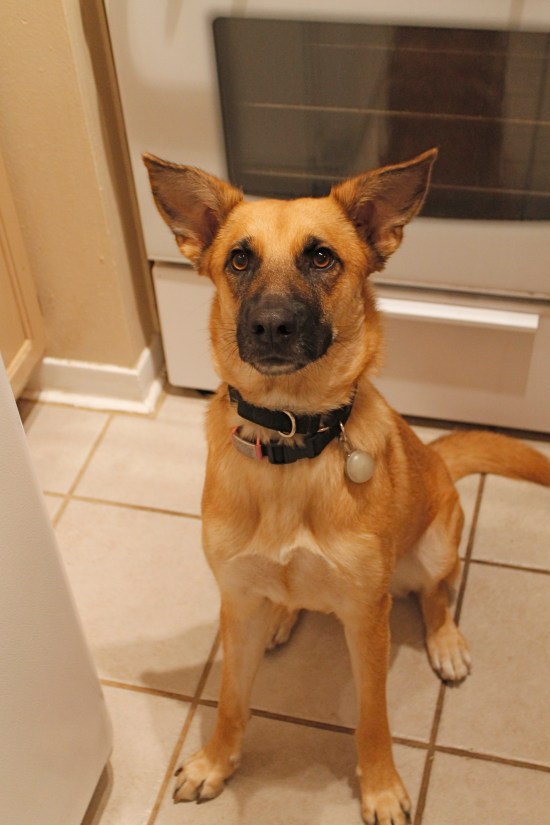
About a week later, L, her partner, and Shiner came in for an evaluation. It was clear from the start that Shiner is not your garden variety reactive dog. She is so worried about dogs that even at a distance of 100 feet or more from a stationary dog, she has trouble walking without tripping over herself. She does her best to run away and hide, but if pushed closer than she is comfortable, she reacts. Explosively. Needless to say, her extreme fear poses a challenge to her people when trying to take her for a neighborhood walk. And with a baby on the way, they knew they had to act quickly if they were to safely keep — or rehome — Shiner.
Through Schrodi Fund, Shiner has been in for several private lessons to help her and her moms get in balance, learn to read each other’s body language to better anticipate Shiner’s worries, and implement various techniques to help Shiner relax and better cope with stress. Shiner has also become a regular in “Tutor Days,” which are daycare days where trainers work with the dog in multiple short sessions using a detailed, tailored training plan for that specific dog.
Shiner’s journey is far from over, but her moms now see a path forward. They love Shiner dearly (they even have a theme song for her — Ryan Adams’ “Goodnight Rose.”), and have renewed their commitment to continue working with her for as long as it takes to ensure her happy ending.
An Ounce of Prevention . . .
Not every case is a dramatic one. A few years back, Schrodi Fund accepted the case of an 85 year old woman who had been gifted an adorable small dog by her family, to keep her company. Unfortunately, the dog turned out to be boisterous and fearful, posing a risk to the owner, who found herself almost being pulled over on neighborhood walks. Living on a fixed income, the woman could not afford to pay for training, even though she didn’t need much. Without an intervention, she would have no choice but to surrender her dog. After four private lessons focused on leash walking and control, the problem was resolved. The woman was able to keep her beloved companion, and the dog was no longer destined for the city shelter.

In my opinion, this is one of the coolest aspects of the program. Rather than only focusing on the dogs whose issues have escalated to a dangerous point, the application review process includes special consideration for those whose concern may be minor — for now. Catching a worry before it becomes a full-blown behavioral issue is so much more efficient and effective than waiting until we’re looking at a dramatic case.
The Nuts and Bolts
Here’s how the program works. Any Austin area resident needing help with their dog who can’t afford full-price training can submit a brief application through the Schrodi Fund website. The review committee looks at the applicant’s stated needs, but also checks for other red flags — early signs of problems that could develop down the road. If the applicant meets the criteria (both merit and need), he is offered a training package that he can afford — no matter how deep the discount necessary. Everybody pays a copay, but that copay might only be $5 in extreme cases.
So far, no qualified applicant has been denied for lack of funds. But this year, demand is higher than ever. The fund is on track to help more than 90 families in 2012, with no indication of a slowdown in 2013. The need in the community for high-quality, low-cost training — especially private training — isn’t going anywhere. And the fund’s ability to change relationships and save lives is only limited by its exposure in the community — which is growing — and the funds available to support it.
This is where you come in.
Tomorrow we launch this year’s fundraiser / giveaway, which we wrote a little bit about yesterday. So tell your friends and join us tomorrow, when you’ll have an opportunity to donate a few holiday dollars to a great cause while putting your name in a drawing for an amazing prize pack of gifts for the pet-lovers in your life (including you)!
TO DONATE: Click here, select “Schrodi Training Fund” from the dropdown menu, and type the word LOTTERY in the “dedication” field to be entered in our holiday giveaway (now through December 7). For more info on the fundraiser and the holiday prize pack, click here!


























 Love and a Six-Foot Leash