Earlier this month — could it have even been the last day of last year? — my mama and I were featured on the Facebook page of My Pit Bull is Family, a very popular organization that promotes the image of dogs like me and the ‘Bug as dogs like me and the ‘Bug (that is, as normal family dogs). The message was clear: “2013 Resolution: FOSTER. Before, as, and after you party tonight, think about a gift you can give this year that will save a life and bring you boundless love in return.” And this mandate was followed by this photo of my mama and me goofing off, and a little snippet of our story together and how we started fostering dogs.

Only the thing is, we’re not fostering anymore — at least, not right now. We fostered and fostered and fostered all the way up until we met my ‘Bug, and then we had to quit. In our home, two dogs is enough dog. Some families can only handle one dog, some families (who I don’t understand) can only handle no dogs, while others can handle three, or four, or even more. Those are some brave families. And they must have some very good dogs.
But the truth is, everybody has their own limits. My mama and dad sometimes say that my brother and I are enough or a project for the two of them, and they wouldn’t be able to handle a third dog. I don’t know what she means, because we are most definitely not a project. We are two dogs. But still — she says that we are still working on our Canine Best Behaviors, and because of this, she doesn’t want to bring more dogs in. On top of that, mama is busy with her job helping other people with their dogs, so more dogs at home sure won’t help that much. And on top of all that, we are going to be adding a new two-legged puppy to our family in a few months, and from what mama has told me, things are going to get real busy for a while after that happens. So for now, we’re not in the game.
But that doesn’t mean you shouldn’t be. Ever since my brother started his advice column, we’ve gotten a number of pee-mails from people wondering if maybe they could start fostering too. Even though I should let my brother answer them, I’m gonna call seniority on his junior self and answer this ponderance for myself. So if you’re thinking about fostering this year, here are my advices on how to get ready:
1. Come up with a plan of how to separate your household.
This could entail a system of dividing your house into two houses, or it could involve a “crate and rotate” system where dogs swap spots every couple of hours. Even if you plan to integrate your dog and the foster dog, you won’t want to do it right away — trust me. And the better you’ve thought through your separation plan, the less you’ll be tempted to rush the dogs together because of convenience. You’ll be more willing to wait until the dogs are actually ready– which is a very good thing.
In fact, many folks foster without ever integrating dogs in their house. I bet you didn’t even know that, huh? When we were fostering, I never even met Little Zee, the apple of my mama’s eye. Other dogs — like Lollie Wonderdog and Dora the Explorer — I got to go for walks with and hang out with supervised sometimes, but for the most part we were separated while at home. Those broads were just too pushy for my tastes, and mama figured out early on that everybody would be happier, the house would be calmer, and there would be less stress if we just took turns. And it worked!
There is a bonus to this plan component too: if it turns out that — despite your best intentions to integrate — you have to keep dogs separate (because they don’t get along, because one is sick, etc), you already know what to do — and nobody gets bounced out of a foster home!

2. Get a really good recall on your dog.
If you’re like most foster folks, you probably want to integrate your new foster dog with your own dogs. That’s great! Dogs can learn all kinds of wonderful things from each other and many enjoy the company, too. But before you take this step, you’ll want to take at least one precaution — train a really good “come when called” with your dog. I’m not just talking about when you ask him for a “sit” and then walk 10 feet away with a piece of rotisserie chicken and then call him. No, I’m talking — teach your dog to come when you call him even if he’s in the middle of playing with a buddy or stalking a cat or rolling in a particularly yummy piece of dead animal in the grass.
Wanna know why? Your foster dog may not come into your home with the best habits, and you don’t want your dog picking up on any bad habits from your foster. So if your dog and your foster start playing a particularly rough game of bitey-face, you will want to call your dog out of it without any drama. Or if you end up with one dog getting into the personal space of another dog, you can get one dog to move without rushing over and grabbing any collars. A good recall will help keep everybody safe.
3. When it comes to integration, you’ll need a helper.
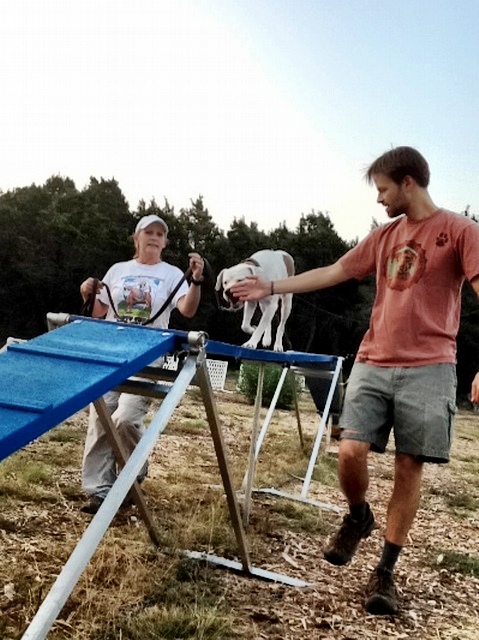
Typically, it took me about 3-5 weeks to integrate fully with foster dogs. Those first few weeks were spent very deliberately building my foster sibling’s basic skills, his relationship with my people, and slowly increasing our exposure to each other. We’d go for walks together, for example. But at first, we’d walk across the street from each other, with different handlers. Eventually, we’d walk side by side, still with two handlers to move us apart if anybody got too excited. Over time, we’d be able to walk together with just one person like my dad, below.

So at first, a second walker was super helpful for us. We got to have all of our fun times together without any of the stress of being forced together before we were ready, see?
4. Have a support network ready.
Speaking of helpers. Fostering is mega-fun, but it’s hard work, too. And it will teach you more than you even realized you didn’t know about dog behavior. But to do all that learning and give your foster dog all she deserves, you’ll need a support network — at least 2-3 people you can lean on when things get hard or when you have questions. These can be me and my ‘Bug (even though we are dogs and not people), folks from your rescue group, your local dog trainer, or just good friends who like dogs and are willing to come over to give you a hug and fix you a strong margarita the first time your foster dog pees on your couch (which may or may not happen).
5. Set your expectations and have lots of patience.
Although I kind of dreaded fostering at first (new dogs in the house sharing my space, my toys, and my peoples? NO way!), mama thought it would be all sunshine and lollipops. Boy was she wrong. In reality, being a good foster family takes a lot of hard work. It takes sacrifices in time and space, it takes a lot of creative thinking and hard work, and it takes a willingness to learn a lot and be flexible. But here’s the secret: we found that with every dog we fostered, it got a little easier. Our expectations became a little more realistic, we got the hang of it a little more, and we gained a sense of humor about the whole thing. By the time we fostered the Little Zee / Curious Georgia flurry, we felt like old pros. After all, those two lived with us while we were selling our house and getting ready to move across the country!

6. Enjoy!
This one might be the most important of all. Yes, fostering is hard work. If you stick with it long enough, then yes, you’ll have to clean up poop inside the house. Yes, you’ll occasionally take an extra long walk in the morning before dawn when it’s freezing outside. Yes, you’ll jump too quickly from one step to another and end up with a disagreement between dogs or a misstep in training or trust. Yes, you’ll have your heart broken by would-be adopters who seemed perfect but disappeared. Or by ones who adopted and then returned. All of these things happen.
But in the grand scheme, these inconveniences are just a drop in the bucket. You will save lives. You will give dogs a chance who wouldn’t have had one. You’ll learn and stretch and grow and cry and laugh. And you’ll fall in love over, and over, and over again.
So what do you think? Could 2013 be your year?

 I bet you didn’t even know that on tomorrow in 1836, Texas officially broke loose of Mexico and became an independent republic? And it wasn’t for another ten years that we joined the US? Yup, it explains a lot, right? It’s why us Texans are such badasses!


















 Love and a Six-Foot Leash